

Zelda Ocarina Songs on a Real 12-Hole Ocarina: Fingerings
Play the Ocarina of Time songs on a real ocarina instrument: the note behind each game button, 12-hole alto C fingerings, and all 12 songs in notes.
Every ocarina song in The Legend of Zelda: Ocarina of Time is built from the same five notes: D, F, A, B and the D an octave above. That makes them some of the easiest tunes to learn on a real ocarina. This page shows which note each game button plays, how to finger those five notes on a 12-hole alto C ocarina, and every song written out in notes. Where to learn each song in the game and what it does is on the ocarina songs page.
Which note does each button play?
Each button plays one fixed note, the same on every version of the game:
| Note | Nintendo 64 | 3DS | Switch 2 | On sheet music |
|---|---|---|---|---|
| D | A | L | L | D4 |
| F | C-Down (▼) | R | R | F4 |
| A | C-Right (▶) | Y | A | A4 |
| B | C-Left (◀) | X | Y | B4 |
| High D | C-Up (▲) | A | X | D5 |
Nintendo’s own sheet music writes the notes on the treble staff from D4, just below the bottom line, up to D5. The ocarina in the game actually sounds an octave higher, D5 to D6. An alto C ocarina works the same way: its music is written an octave below what it plays. So a 12-hole alto C plays the songs at the pitch you hear in the game.
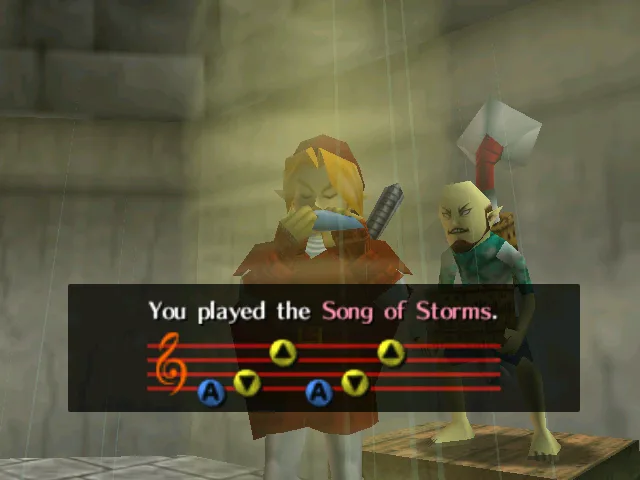
The Nintendo 64 version can also bend notes: hold Z to play a semitone lower, hold R to play a semitone higher, tilt the Control Stick up or down to bend the note and left or right for vibrato. None of the 12 songs needs any of that. They use only the five plain notes.
How do you finger the five notes on a 12-hole ocarina?
The diagrams show a 12-hole alto C ocarina from above, mouthpiece toward you. All five notes sit in the lower half of the instrument’s range, and none of them needs the subholes.
- D: cover every main hole, then lift the right pinky.
- F: keep the left hand down and only the right index finger on the right hand.
- A: right hand fully off; on the left hand, lift the ring finger. The left pinky stays down to steady the instrument.
- B: as A, and lift the left middle finger too. Only the left index and pinky stay down, with both thumbs.
- High D: lift every top hole except the left pinky, and lift the left thumb. The right thumb stays on.
The right thumb holds the instrument for all five notes. A and B differ by one finger, and D and F by two (the right middle and ring fingers), so the hardest moves are the big ones: from D straight to high D in the Minuet of the Forest, or the quick D–F swaps of the Bolero of Fire.
What are the notes for every song?
High D is written D′. The notes are exactly what the game wants you to play; the game only checks the notes, not the rhythm.
| Song | Nintendo 64 | Switch 2 | Notes |
|---|---|---|---|
| Zelda’s Lullaby | ◀ ▲ ▶ ◀ ▲ ▶ | Y X A Y X A | B D′ A B D′ A |
| Epona’s Song | ▲ ◀ ▶ ▲ ◀ ▶ | X Y A X Y A | D′ B A D′ B A |
| Saria’s Song | ▼ ▶ ◀ ▼ ▶ ◀ | R A Y R A Y | F A B F A B |
| Sun’s Song | ▶ ▼ ▲ ▶ ▼ ▲ | A R X A R X | A F D′ A F D′ |
| Song of Time | ▶ A ▼ ▶ A ▼ | A L R A L R | A D F A D F |
| Song of Storms | A ▼ ▲ A ▼ ▲ | L R X L R X | D F D′ D F D′ |
| Minuet of the Forest | A ▲ ◀ ▶ ◀ ▶ | L X Y A Y A | D D′ B A B A |
| Bolero of Fire | ▼ A ▼ A ▶ ▼ ▶ ▼ | R L R L A R A R | F D F D A F A F |
| Serenade of Water | A ▼ ▶ ▶ ◀ | L R A A Y | D F A A B |
| Nocturne of Shadow | ◀ ▶ ▶ A ◀ ▶ ▼ | Y A A L Y A R | B A A D B A F |
| Requiem of Spirit | A ▼ A ▶ ▼ A | L R L A R L | D F D A F D |
| Prelude of Light | ▲ ▶ ▲ ▶ ◀ ▲ | X A X A Y X | D′ A D′ A B D′ |
| Scarecrow Song | Your own eight notes | Your own eight notes | Write yours down in letters |
The six story songs are a three-note phrase played twice, so learn the first half and repeat it. The warp songs do not repeat. The Scarecrow Song is whatever eight notes you played to Bonooru; if you want it on a real ocarina too, note it down with this table (see the Scarecrow Song page).
Why is each song only a few notes long?
What you play in the game is each song’s main phrase. Nintendo has posted sheet music for all 12 songs, with an ocarina fingering guide, on the game’s official Japanese website, and it prints exactly that phrase with its rhythm. Several songs also play in the game as longer music: Saria’s melody keeps playing in the right tunnels of the Lost Woods, the Song of Storms is the tune the man in the Kakariko windmill plays, and Epona’s Song is the song Malon sings at Lon Lon Ranch. Those longer versions start with the same notes as the table, but the rest is a full arrangement. To play it, get sheet music for the piece.
For rhythm, play along with the game: in the Switch 2 remake each learned song has a page in the songbook where you can listen to it.
Can you play a real ocarina into the Switch 2 remake?
Yes. In the Switch 2 remake you can hum or play a real instrument into the Nintendo Switch 2 microphone, and Link plays the tune on his ocarina. The ocarina screen has Practice audio input on the − Button to check your notes without triggering a song, and Reset audio input on the + Button.
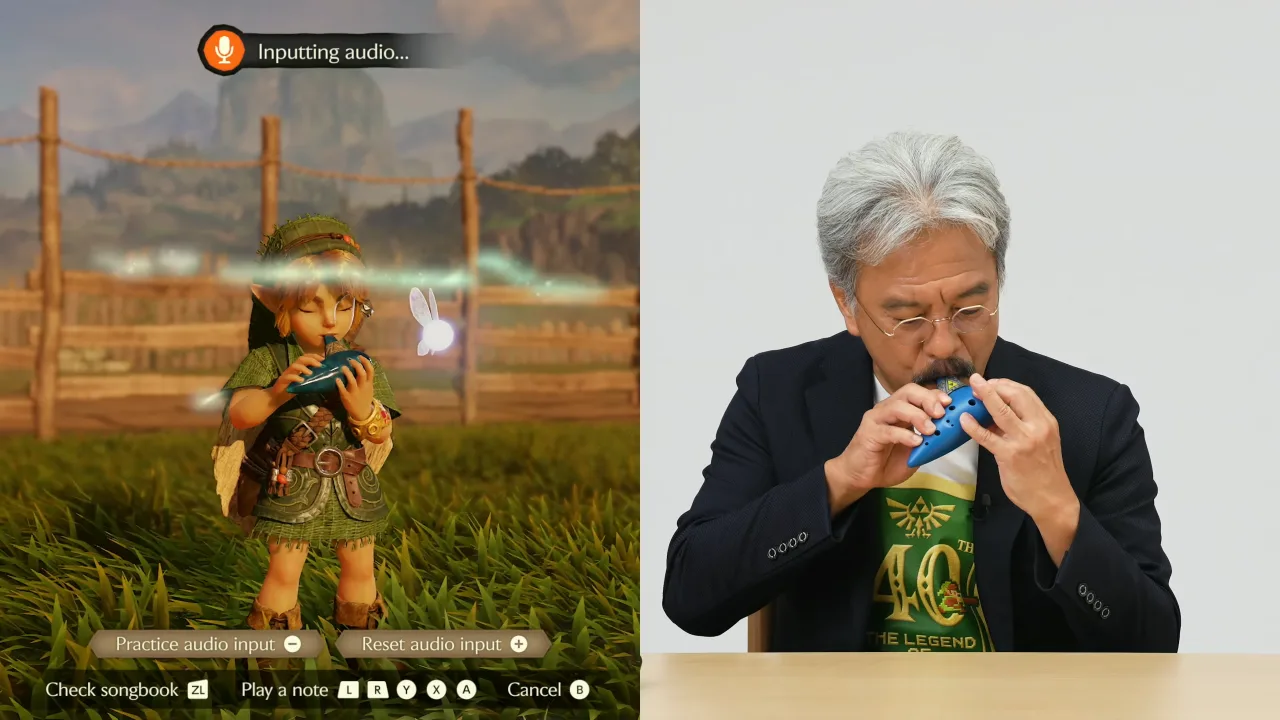
- Only songs Link has already learned are recognised. You cannot play a warp song early.
- Nintendo notes that an external microphone, or a headset plugged into the Nintendo Switch 2 Pro Controller, may not be picked up correctly. Play toward the console.
- The game is said to listen for the steps between notes rather than exact pitch, so an ocarina in another key may still work. Buttons always work if it does not.
Which ocarina should you buy?
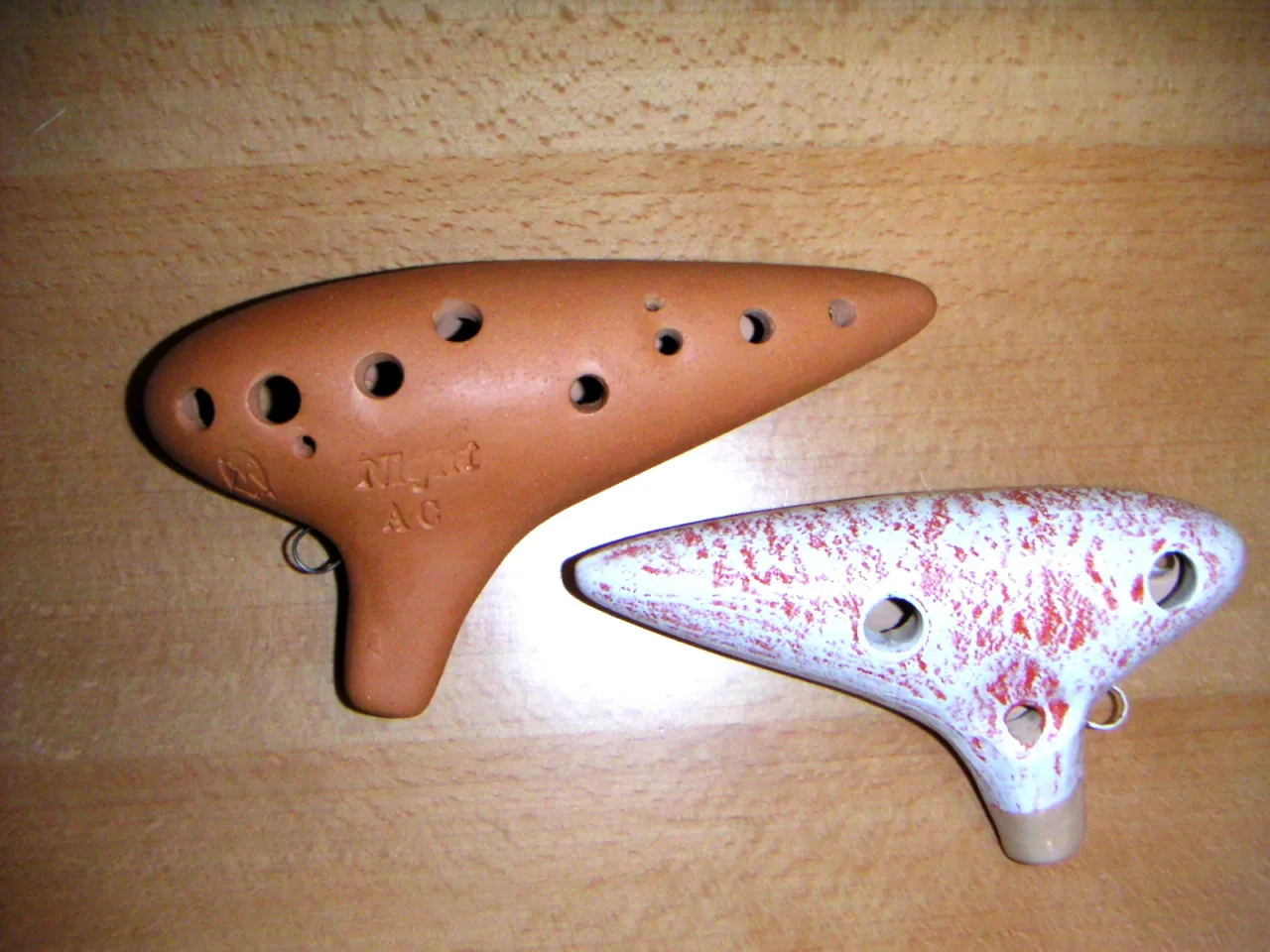
- A 12-hole alto C is the easy choice. Its range runs from A to F, written A3 to F5 and sounding an octave higher, so the five notes sit in the comfortable middle. It is also the most common transverse ocarina, so fingering charts and songbooks for it are easy to find.
- 10 and 11 holes work too. They have the same fingering for these notes; the extra subholes on a 12-hole only add the low B and A, which no Zelda song uses.
- 6-hole pendants are a compromise. They use a different fingering system with crossed patterns and cover about an octave, at most an octave and a whole step. The high D is at the top of the range or past it, depending on the model.
- Other keys play the same fingerings at a different pitch. An alto G or F ocarina plays the songs correctly in its own key, just not at the game’s pitch.
- Ceramic or plastic. Most ceramic ocarinas are porous clay that soaks up moisture, so they do not get wet inside during long sessions, but they break if dropped. Plastic survives drops and is cheap, but moisture builds up inside and dulls the tone over a long session.
The downsides are real. A 12-hole alto has quiet low notes and loud high notes, so the low D needs a gentle breath and the high D a firmer one. Pitch rises when you blow harder and falls when you blow softer, so the same fingering can sound sharp or flat; you have to learn how hard to blow on each note. Souvenir ocarinas with rows of identical holes are usually not tuned at all and are not worth buying to play music.
This page has Amazon links. If you buy through one, QuestFern may earn a commission at no extra cost to you.How the site is funded
Amazon has plenty of 12-hole alto C ocarinas, in ceramic and plastic. Check that the listing says both 12 holes and alto C, and that it comes with a fingering chart.
Is there an official Ocarina of Time ocarina?
Two official ocarinas came out with the Switch 2 remake.
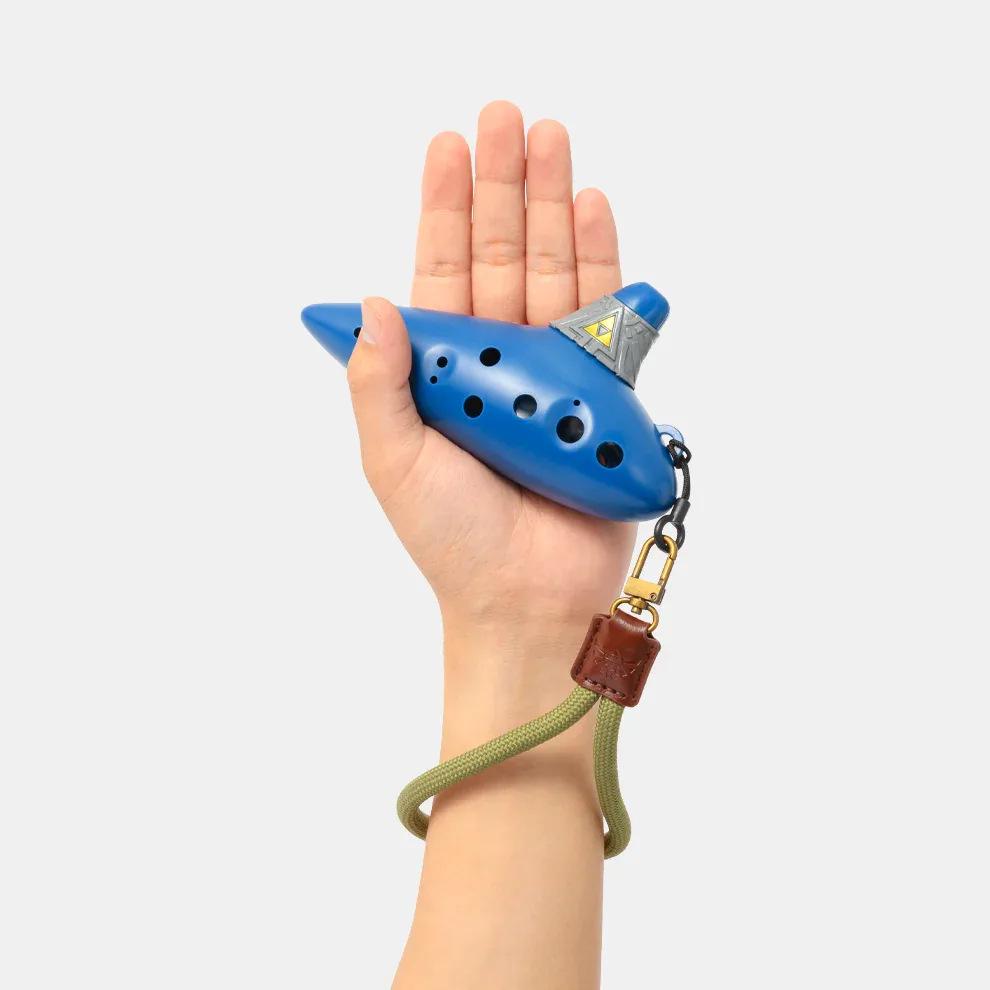
- Nintendo’s playable Ocarina of Time. A real wind instrument made by Nintendo, with a strap, a fingering chart and sheet music for the 12 songs. Its photos show the 12-hole layout, and its chart notes that it sounds an octave above the written music, the same as an alto C. Nintendo Store Japan lists it at 5,500 yen; it showed as sold out on November 19, 2026.
- HORI’s Electric Ocarina of Time. An electronic instrument that runs on three AA batteries. It is not a game controller, but the remake’s microphone input recognises it.
Other blue ocarinas with a Triforce on the mouthpiece, sold online or at fan shops, are not official products. Some are well-made 12-hole instruments; check the hole count and key like any other ocarina.
What should you read next?
- Ocarina songs: where each song is learned and what it does
- Scarecrow Song: the song you write yourself, and where Pierre appears
- Every new feature in the remake: the songbook, microphone input and other changes
FAQ
What notes does the ocarina play in Ocarina of Time?
What kind of ocarina do I need to play the Zelda songs?
Can I play the Zelda songs on a 6-hole ocarina?
Can a real ocarina play the songs in the Switch 2 remake?
Is there an official Ocarina of Time ocarina?
Why are the songs so short compared with the music in the game?
Related Articles
guides
Ocarina of Time Remake Items and Capacity Upgrades
Find the remake’s main tools and upgrade your wallet, Bomb Bag, seed bag and quiver, with the new rupee limits and horseback archery score.
guides
Ocarina of Time Remake Hookshot: Dampé's Race and Exit
Get the Hookshot in the Ocarina of Time remake: open the misty grave in Kakariko Graveyard, keep up with Dampé, hook out to the windmill and win his one-minute race.
guides
Ocarina of Time Remake Megaton Hammer: Location and Uses
Get the Megaton Hammer in the Switch 2 Ocarina of Time remake and see every place it is needed, from Fire Temple switches and Volvagia to four later dungeons.
Was this helpful?
Thanks for the feedback!